
Hyundai i30 (PD): What to do in an emergency / Jump starting. Jump starting procedure
Jump starting can be dangerous if done incorrectly. Follow the jump starting procedure in this section to avoid serious injury or damage to your vehicle. If in doubt about how to properly jump start your vehicle, we strongly recommend that you have a service technician or towing service do it for you.
WARNING
To prevent SERIOUS INJURY or DEATH to you or bystanders, always follow these precautions when working near or handling the battery:
 Always read and follow
instructions carefully
when handling a battery.
Always read and follow
instructions carefully
when handling a battery.
 Wear eye protection
designed to protect the
eyes from acid splashes.
Wear eye protection
designed to protect the
eyes from acid splashes.
 Keep all flames, sparks,
or smoking materials
away from the battery.
Keep all flames, sparks,
or smoking materials
away from the battery.
 Hydrogen is always
present in battery cells,
is highly combustible,
and may explode if ignited.
Hydrogen is always
present in battery cells,
is highly combustible,
and may explode if ignited.
 Keep batteries out of
reach of children.
Keep batteries out of
reach of children.
 Batteries contain sulfuric
acid which is highly
corrosive. Do not allow
acid to contact your
eyes, skin or clothing.
Batteries contain sulfuric
acid which is highly
corrosive. Do not allow
acid to contact your
eyes, skin or clothing.
If acid gets into your eyes, flush your eyes with clean water for at least 15 minutes and get immediate medical attention. If acid gets on your skin, thoroughly wash the area. If you feel pain or a burning sensation, get medical attention immediately.
- When lifting a plastic-cased battery, excessive pressure on the case may cause battery acid to leak. Lift with a battery carrier or with your hands on opposite corners.
- Do not attempt to jump start your vehicle if your battery is frozen.
- NEVER attempt to recharge the battery when the vehicle’s battery cables are connected to the battery.
- The electrical ignition system works with high voltage. NEVER touch these components with the engine running or when the ignition switch is in the ON position.
- Do not allow the (+) and (-) jumper cables to touch. It may cause sparks.
- The battery may rupture or explode when you jump start with a low or frozen battery.
NOTICE
To prevent damage to your vehicle:
- Only use a 12-volt power supply (battery or jumper system) to jump start your vehicle.
- Do not attempt to jump start your vehicle by push-starting.
Information
An inappropriately disposed battery can be harmful to the environment and human health. Dispose the battery according to your local law(s) or regulations.
Jump starting procedure
1. Position the vehicles close enough that the jumper cables will reach, but do not allow the vehicles to touch.
2. Avoid fans or any moving parts in the engine compartment at all times, even when the vehicles are turned off.
3. Turn off all electrical devices such as radios, lights, air conditioning, etc. Put the vehicles in P (Park, for automatic transmission/dual clutch transmission vehicle) or neutral (for manual transmission vehicle), and set the parking brakes. Turn both vehicles OFF.
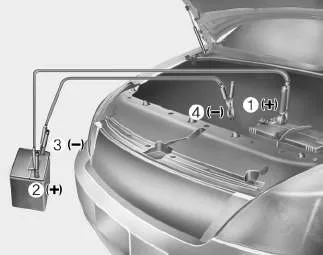
4. Connect the jumper cables in the exact sequence shown in the illustration. First connect one jumper cable to the red, positive (+) jumper terminal of your vehicle (1).
5. Connect the other end of the jumper cable to the red, positive (+) battery/jumper terminal of the assisting vehicle (2).
6. Connect the second jumper cable to the black, negative (-) battery/ chassis ground of the assisting vehicle (3).
7. Connect the other end of the second jumper cable to the black, negative (-) chassis ground of your vehicle (4).
Do not allow the jumper cables to contact anything except the correct battery or jumper terminals or the correct ground. Do not lean over the battery when making connections.
8. Start the engine of the assisting vehicle and let it run at approximately 2,000 rpm for a few minutes. Then start your vehicle.
If your vehicle will not start after a few attempts, it probably requires servicing. In this event please seek qualified assistance. If the cause of your battery discharging is not apparent, have your vehicle checked by a HYUNDAI authorised repairer.
Disconnect the jumper cables in the exact reverse order you connected them:
1. Disconnect the jumper cable from the black, negative (-) chassis ground of your vehicle (4).
2. Disconnect the other end of the jumper cable from the black, negative (-) battery/chassis ground of the assisting vehicle (3).
3. Disconnect the second jumper cable from the red, positive (+) battery/jumper terminal of the assisting vehicle (2).
4. Disconnect the other end of the jumper cable from the red, positive (+) jumper terminal of your vehicle (1).
If the engine doesn't turn over or turns over slowly Be sure the shift lever is in N (Neutral) or P (Park) if it is an automatic transmission/dual clutch transmission vehicle.
If your temperature gauge indicates overheating, you experience a loss of power, or hear loud pinging or knocking, the engine may be overheating.
Other information:
Hyundai i30 (PD) 2018-2024 Owner's Manual: Air cleaner
Filter replacement The air cleaner filter can be cleaned for inspection using compressed air. Do not attempt to wash or to rinse it, as water will damage the filter. If soiled, the air cleaner filter must be replaced. 1. Loosen the air cleaner cover attaching clips and open the cover.
Hyundai i30 (PD) 2018-2024 Owner's Manual: Interior care
Interior general precautions Prevent chemicals such as perfume, cosmetic oil, sun cream, hand cleaner and air freshener from contacting the interior parts because they may cause damage or discoloration. If they do contact the interior parts, wipe them off immediately.
Categories
- Manuals Home
- Hyundai i30 Owners Manual
- LKA system operation
- Engine coolant
- Battery replacement
- New on site
- Most important about car
