
Hyundai i30 (PD): Jump starting / Jump starting procedure
1. Position the vehicles close enough that the jumper cables will reach, but do not allow the vehicles to touch.
2. Avoid fans or any moving parts in the engine compartment at all times, even when the vehicles are turned off.
3. Turn off all electrical devices such as radios, lights, air conditioning, etc. Put the vehicles in P (Park, for automatic transmission/dual clutch transmission vehicle) or neutral (for manual transmission vehicle), and set the parking brakes. Turn both vehicles OFF.
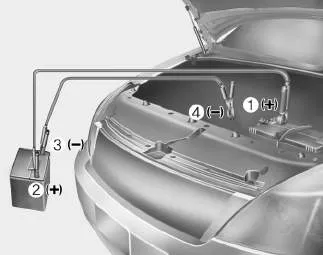
4. Connect the jumper cables in the exact sequence shown in the illustration. First connect one jumper cable to the red, positive (+) jumper terminal of your vehicle (1).
5. Connect the other end of the jumper cable to the red, positive (+) battery/jumper terminal of the assisting vehicle (2).
6. Connect the second jumper cable to the black, negative (-) battery/ chassis ground of the assisting vehicle (3).
7. Connect the other end of the second jumper cable to the black, negative (-) chassis ground of your vehicle (4).
Do not allow the jumper cables to contact anything except the correct battery or jumper terminals or the correct ground. Do not lean over the battery when making connections.
8. Start the engine of the assisting vehicle and let it run at approximately 2,000 rpm for a few minutes. Then start your vehicle.
If your vehicle will not start after a few attempts, it probably requires servicing. In this event please seek qualified assistance. If the cause of your battery discharging is not apparent, have your vehicle checked by a HYUNDAI authorised repairer.
Disconnect the jumper cables in the exact reverse order you connected them:
1. Disconnect the jumper cable from the black, negative (-) chassis ground of your vehicle (4).
2. Disconnect the other end of the jumper cable from the black, negative (-) battery/chassis ground of the assisting vehicle (3).
3. Disconnect the second jumper cable from the red, positive (+) battery/jumper terminal of the assisting vehicle (2).
4. Disconnect the other end of the jumper cable from the red, positive (+) jumper terminal of your vehicle (1).
Jump starting can be dangerous if done incorrectly. Follow the jump starting procedure in this section to avoid serious injury or damage to your vehicle.
If your temperature gauge indicates overheating, you experience a loss of power, or hear loud pinging or knocking, the engine may be overheating.
Other information:
Hyundai i30 (PD) 2018-2024 Owner's Manual: Air conditioner compressor label, Refrigerant label, Declaration of conformity, Air conditioner compressor label
A compressor label informs you the type of compressor your vehicle is equipped with such as model, supplier part number, production number, refrigerant (1) and refrigerant oil (2). Refrigerant label The refrigerant label provides information such as refrigerant type and amount.
Hyundai i30 (PD) 2018-2024 Owner's Manual: Fuel label
Petrol engine The fuel label is attached on the fuel filler door. A. Octane rating of unleaded petrol 1) RON/ROZ : Research Octane Number 2) (R+M)/2, AKI : Anti Knock Index B. Identifiers for Petrol-type fuels ❈ This symbol means usable fuel.
Categories
- Manuals Home
- Hyundai i30 Owners Manual
- Driving your vehicle
- Cargo security screen (wagon)
- Maintenance
- New on site
- Most important about car
