
Hyundai i30 (PD): Seats / Rear seats. Armrest, Carrying long/narrow cargo
Folding the rear seat
The rear seatbacks can be folded to facilitate carrying long items or to increase the luggage capacity of the vehicle.
WARNING
- Never allow passengers to sit on top of the folded down seatback whilst the vehicle is moving. This is not a proper seating position and no seat belts are available for use. This could result in serious injury or death in case of an accident or sudden stop.
- Objects carried on the folded down seatback should not extend higher than the top of the front seatbacks.This could allow cargo to slide forward and cause injury or damage during sudden stops.
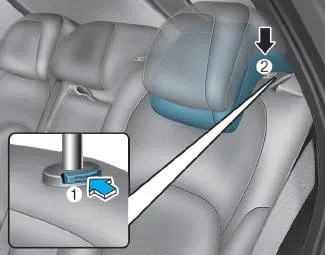
To fold down the rear seatback:
1. Set the front seatback to the upright position and if necessary, slide the front seat forward.
2. Lower the rear head restraints to the lowest position.
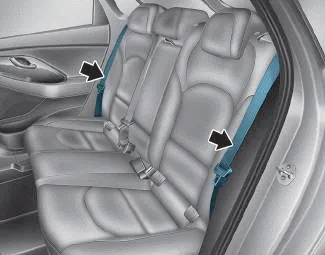
3. Locate the seatbelt toward the outboard position before folding down the seatback to avoid the seatbelt system interfering with the seatback.
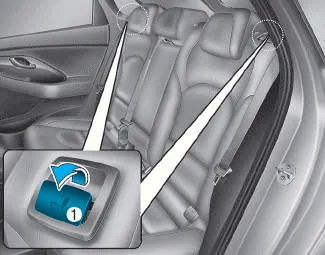
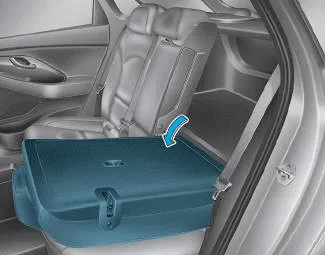
4. Pull up the seatback folding lever (1), then fold the seat toward the front of the vehicle.
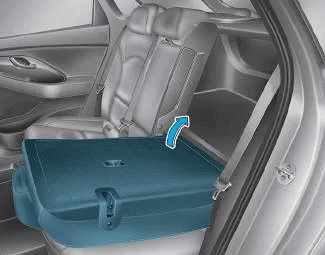
5. To use the rear seat, lift and push the seatback rearward.
Push the seatback firmly until it clicks into place. Make sure the seatback is locked in place.
WARNING
When returning the rear seatback from a folded to an upright position, hold the seatback and return it slowly. Be careful not to damage the seat belt webbing or buckle. Do not allow the seat belt webbing or buckle to get caught or pinched in the rear seat. Ensure that the seatback is completely locked into its upright position by pushing on the top of the seatback. In an accident or sudden stop, the unlocked seatback could allow cargo to move forward with great force and enter the passenger compartment, which could result in serious injury or death.
CAUTION
Rear seat belts
When returning the rear seatbacks to the upright position, remember to return the rear shoulder belts to their proper position.
WARNING
Do not place objects in the rear seats, since they cannot be properly secured and may hit vehicle occupants in a collision causing serious injury or death.
WARNING
Make sure the engine is off, the shift lever is in P (Park), and the parking brake is securely applied whenever loading or unloading cargo. Failure to take these steps may allow the vehicle to move if the shift lever is inadvertently moved to another position.
Armrest, Carrying long/narrow cargo
Armrest
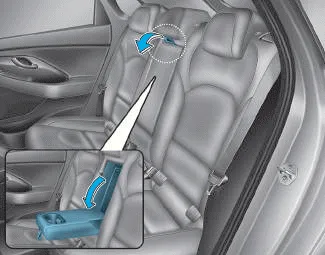
The armrest is located in the centre of the rear seat. Pull the armrest down from the seatback to use it.
Carrying long/narrow cargo
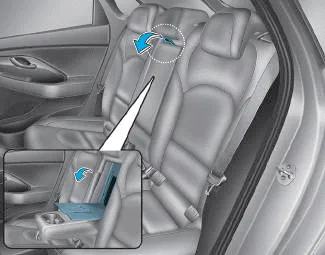
Additional cargo space is provided to accommodate long/narrow cargo (skis, poles, etc.) not able to fit properly in the luggage compartment when closed.
1.Pull the armrest down.
2.Pull the cover down whilst pushing the release lever down.
CAUTION
- Be careful when loading cargo through the rear passenger seats to prevent damage to the vehicle interior.
- When cargo is loaded through the rear passenger seats, ensure the cargo is properly secured to prevent it from moving whilst driving.
WARNING
Cargo should always be secured to prevent it from being thrown about the vehicle in a collision and causing injury to the vehicle occupants. Do not place objects in the rear seats, since they cannot be properly secured and may hit the front seat occupants in a collision.
The front seat can be adjusted by using the control lever (or knob) or switches located on the outside of the seat cushion. Before driving, adjust the seat to the proper position so that you can easily control the steering wheel, foot pedals and controls on the instrument panel.
The vehicle’s front and rear seats have adjustable head restraints. The head restraints provide comfort for passengers, but more importantly they are designed to help protect passengers from whiplash and other neck and spinal injuries during an accident, especially in a rear impact collision.
Other information:
Hyundai i30 (PD) 2018-2024 Owner's Manual: Special driving conditions
Hazardous driving conditions When hazardous driving elements are encountered such as water, snow, ice, mud and sand, take the following precautions: Drive cautiously and maintain a longer braking distance. Avoid abrupt braking or steering.
Hyundai i30 (PD) 2018-2024 Owner's Manual: Maintenance when towing a trailer
Your vehicle will need service more often when you regularly pull a trailer. Important items to pay particular attention to include engine oil, automatic transmission fluid, axle lubricant and cooling system fluid. Brake condition is another important item to frequently check.
Categories
- Manuals Home
- Hyundai i30 Owners Manual
- Headlamp, static bending lamp, position lamp, turn signal lamp and daytime running light bulb replacement
- Your vehicle at a glance
- Maintenance
- New on site
- Most important about car
