
Hyundai i30 (PD): Braking system / AUTO HOLD. Warning messages
The Auto Hold maintains the vehicle in a standstill even though the brake pedal is not depressed, after the driver brings the vehicle to a complete stop by depressing the brake pedal.
To apply :
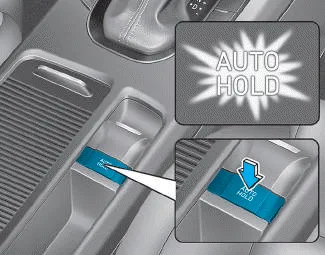
1. With the driver's door, engine bonnet and tailgate closed, fasten the driver's seat belt or depress the brake pedal and then press the [AUTO HOLD] switch. The white AUTO HOLD indicator will come on and the system will be in the standby position.
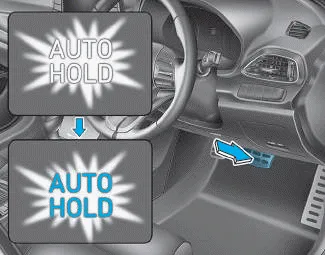
2. When you stop the vehicle completely by depressing the brake pedal, the Auto Hold maintains the brake pressure to hold the vehicle stationary. The indicator changes from white to green.
3. The vehicle will remain stationary even if you release the brake pedal.
4. If EPB is applied, Auto Hold will be released.
To release :
- If you press the accelerator pedal with the shift lever in D (Drive), R (Reverse) or manual shift mode, the Auto Hold will be released automatically and the vehicle will start to move. The AUTO HOLD indicator changes from green to white.
- If the vehicle is restarted using the cruise control toggle switch (RES+ or SET-) whilst Auto Hold and cruise control is operating, the Auto Hold will be released regardless of accelerator pedal operation. The AUTO HOLD indicator changes from green to white. (if equipped with cruise control system)
WARNING
When the AUTO HOLD is automatically released by depressing the accelerator pedal, always take a look around your vehicle. Slowly depress the accelerator pedal for a smooth start.
To cancel :
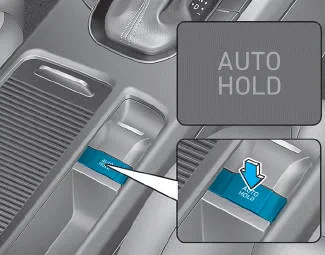
1. Depress the brake pedal.
2. Press the [AUTO HOLD] switch.
The AUTO HOLD indicator will turn off.
WARNING
To prevent, unexpected and sudden vehicle movement, ALWAYS press your foot on the brake pedal to cancel the Auto Hold before you:
- Drive downhill.
- Drive the vehicle in R (Reverse).
- Park the vehicle.
Information
- Auto Hold does not operate when:
- The driver's seat belt is unfastened and driver's door is opened
- The engine bonnet is opened
- The shift lever is in P (Park) or R (Reverse)
- The EPB is applied - For your safety, Auto Hold automatically
switches to EPB when:
- The driver's seat belt is unfastened and the driver's door is opened
- The engine bonnet is opened with the shift lever in D (Drive)
- The vehicle stops for more than 10 minutes
- The vehicle stands on a steep slope
- The vehicle moves several times In these cases, the parking brake warning light comes on, the AUTO HOLD indicator changes from green to white, and a warning sound and a message will appear to inform you that EPB has been automatically engaged. Before driving off again, press the foot brake pedal, check the surrounding area near your vehicle and release the parking brake manually with the EPB switch. - Whilst Auto Hold is operating, you may hear mechanical noise. However, it is normal operating noise.
NOTICE
If the AUTO HOLD indicator changes to yellow, the Auto Hold is not working properly.We recommend that you contact a HYUNDAI authorised repairer.
WARNING
- Depress the accelerator pedal slowly when you start the vehicle.
- For your safety, cancel the Auto Hold when you drive downhill, back up the vehicle or park the vehicle.
NOTICE
If there is a malfunction with the driver's door or engine bonnet open detection system, the Auto Hold may not work properly.
We recommend that you contact a HYUNDAI authorised repairer.
Warning messages
Parking brake automatically locked
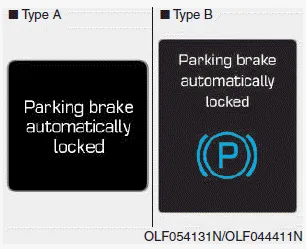
When the EPB is applied from Auto Hold, a warning will sound and a message will appear.
AUTO HOLD deactivating. Press brake pedal
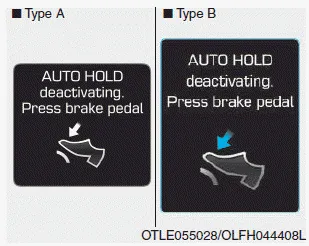
When the conversion from Auto Hold to EPB is not working properly a warning will sound and a message will appear.
When this message is displayed, the Auto Hold and EPB may not operate. For your safety, depress the brake pedal.
Press brake pedal to deactivate AUTO HOLD

If you did not apply the brake pedal when you released the Auto Hold by pressing the [AUTO HOLD] switch, a warning will sound and a message will appear.
AUTO HOLD conditions not met. Close door and bonnet, then fasten seatbelt
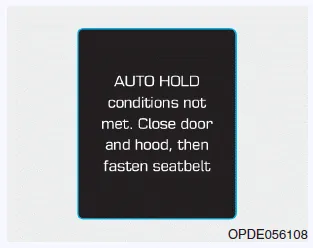
When you press the [AUTO HOLD] switch, if the driver's door and engine bonnet are not closed or the driver's seat belt is unfastened, a warning will sound and a message will appear on the LCD display. At this moment, press the [AUTO HOLD] button after closing the driver's door and engine bonnet, and fastening the seat belt.
If there is a problem with the brake pedal whilst driving, emergency braking is possible by pulling up and holding the EPB switch. Braking is possible only whilst you are holding the EPB switch.
WARNING An Anti-Lock Braking System (ABS) or an Electronic Stability Control (ESC) system will not prevent accidents due to improper or dangerous driving manoeuvres.
Other information:
Hyundai i30 (PD) 2018-2024 Owner's Manual: Smart Cruise Control Vehicleto- Vehicle Distance
To set Vehicle-to-Vehicle Distance When the Smart Cruise Control System is ON, you can set and maintain the distance from the vehicle ahead of you without pressing the accelerator or brake pedal. Each time the button is pressed, the vehicle to vehicle distance changes as follows: For example, if you drive at 56 mph (90 km/h),
Hyundai i30 (PD) 2018-2024 Owner's Manual: Check tyre pressure
You can check the tyre pressure in the Assist mode on the cluster. Refer to the "LCD Display Modes" in chapter 3. Tyre pressure is displayed after a few minutes of driving after initial engine start up. If tyre pressure is not displayed when the vehicle is stopped, "Drive to display" message will appear.
Categories
- Manuals Home
- Hyundai i30 Owners Manual
- LKA system operation
- Battery replacement
- Cruise control
- New on site
- Most important about car
