
Hyundai i30 (PD): If you have a flat tyre (with tyre mobility kit) / Components of the Tyre Mobility Kit
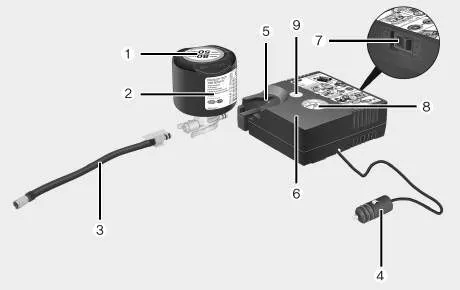
â– Type A

â– Type B
1. Speed-restriction label
2. Sealant bottle and label with speed
restriction
3. Filling hose from sealant bottle to
wheel
4. Connectors and cable for the power
outlet direct connection
5. Holder for the sealant bottle
6. Compressor
7. ON/OFF switch
8. Pressure gauge for displaying the
tyre inflation pressure
9. Button for reducing the tyre inflation
pressure
Connectors, cable and connection hose are stored in the compressor housing.
Strictly follow the specified sequence, otherwise the sealant may escape under high pressure.
WARNING
Expired sealant
Do not use the Tyre sealant after the sealant has expired (i.e. pasted the expiration date on the sealant container). This can increase the risk of tyre failure.
WARNING
Sealant
- Keep out of reach of children.
- Avoid contact with eyes.
- Do not swallow.
Park your car at the side of the road so that you can work with the Tyre Mobility Kit away from moving traffic. To be sure your vehicle will not move, even when you're on fairly level ground, always set your parking brake.
CAUTION Detach the speed restriction label (1) from the sealant bottle (2), and place it in a highly visible place inside the vehicle such as on the steering wheel to remind the driver not to drive too fast.
Other information:
Hyundai i30 (PD) 2018-2024 Owner's Manual: Smart Cruise Control Vehicleto- Vehicle Distance
To set Vehicle-to-Vehicle Distance When the Smart Cruise Control System is ON, you can set and maintain the distance from the vehicle ahead of you without pressing the accelerator or brake pedal. Each time the button is pressed, the vehicle to vehicle distance changes as follows: For example, if you drive at 56 mph (90 km/h),
Hyundai i30 (PD) 2018-2024 Owner's Manual: Check tyre inflation pressure
Check your tyres, including the spare tyre, once a month or more. How to check Use a good quality tyre pressure gauge to check tyre pressure. You can not tell if your tyres are properly inflated simply by looking at them. Radial tyres may look properly inflated when they are under-inflated.
Categories
- Manuals Home
- Hyundai i30 Owners Manual
- Low tyre pressure telltale
- Specifications & Consumer information
- Maintenance
- New on site
- Most important about car
