
Hyundai i30 (PD): If you have a flat tyre (with tyre mobility kit) / Using the Tyre Mobility Kit
CAUTION
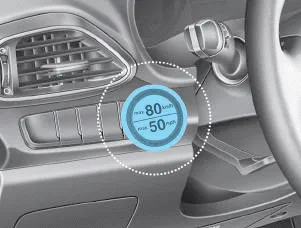
Detach the speed restriction label (1) from the sealant bottle (2), and place it in a highly visible place inside the vehicle such as on the steering wheel to remind the driver not to drive too fast.
1. Shake the sealant bottle (2).
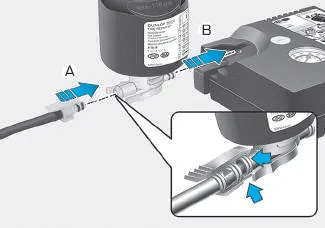
â– Type A
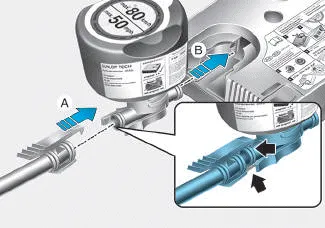
â– Type B
2. Connect the filling hose (3) to the sealant bottle (2) in the direction of (A) and connect the sealant bottle to the compressor (6) in the direction of (B).
3. Ensure that the compressor is switched OFF.
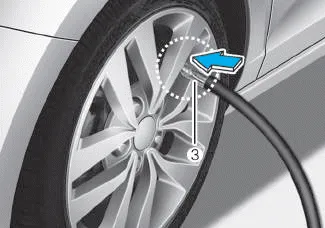
4. Unscrew the valve cap from the valve of the defective wheel and screw the filling hose (3) of the sealant bottle onto the valve.
CAUTION
Securely install the sealant filling hose to the valve. If not, sealant may flow backward, possibly clogging the filling hose.
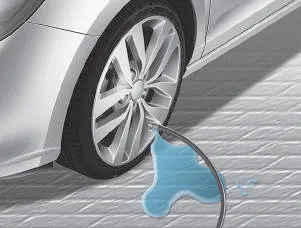
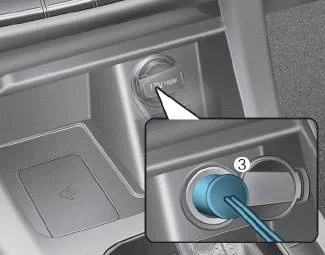
5. Plug the compressor power cord (4) into the vehicle power outlet.
NOTICE
Only use the front passenger side power outlet when connecting the power cord.
6. With the ignition switch in the ON position, switch on the compressor and let it run for approximately 5~7 minutes to fill the sealant up to proper pressure. (refer to the Tyre and Wheels, chapter 8). The inflation pressure of the tyre after filling is unimportant and will be checked/corrected later.
Be careful not to overinflate the tyre and stay away from the tyre when filling it.
CAUTION
Tyre pressure
Do not attempt to drive your vehicle if the tyre pressure is below 200 kPa (29 psi). This could result in an accident due to sudden tyre failure.
7. Switch off the compressor.
8. Detach the hoses from the sealant bottle connector and from the tyre valve.
Return the Tyre Mobility Kit to its storage location in the vehicle.
WARNING
Carbon monoxide
Do not leave your vehicle running in a poorly ventilated area for extended periods of time. Carbon monoxide poisoning and suffocation can occur.
Distributing the sealant

9. Immediately drive approximately 7~10 km (4~6 miles or, about 10min) to evenly distribute the sealant in the tyre.
Do not exceed a speed of 80 km/h (50 mph). If possible, do not fall below a speed of 20 km/h (12 mph).
Whilst driving, if you experience any unusual vibration, ride disturbance or noise, reduce your speed and drive with caution until you can safely pull off of the side of the road.
Call for road side service or towing.
â– Type A â– Type B 1. Speed-restriction label 2. Sealant bottle and label with speed restriction 3. Filling hose from sealant bottle to wheel 4.
1. After driving approximately 7~10 km (4~6 miles or about 10 min), stop at a safety location. 2. Connect the filling hose (3) of the compressor directly to the tyre valve.
Other information:
Hyundai i30 (PD) 2018-2024 Owner's Manual: Fuel filter (for diesel)
Draining water from fuel filter The fuel filter in the diesel engine operates the critical function of separating water from the fuels and preventing accumulating of water in the base. When enough water is accumulated inside the fuel filter, the warning light () illuminates with the ignition switch in the ON position.
Hyundai i30 (PD) 2018-2024 Owner's Manual: Interior care
Interior general precautions Prevent chemicals such as perfume, cosmetic oil, sun cream, hand cleaner and air freshener from contacting the interior parts because they may cause damage or discoloration. If they do contact the interior parts, wipe them off immediately.
Categories
- Manuals Home
- Hyundai i30 Owners Manual
- Engine coolant
- Maintenance services
- Battery replacement
- New on site
- Most important about car
