
Hyundai i30 (PD): What to do in an emergency / Towing
Towing service
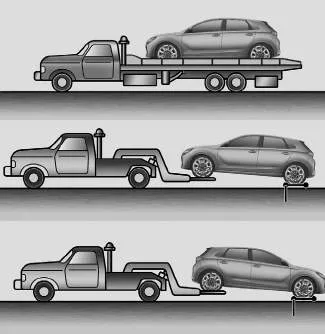
If emergency towing is necessary, we recommend having it done by a HYUNDAI authorised repairer or a commercial tow-truck service.
Proper lifting and towing procedures are necessary to prevent damage to the vehicle. The use of wheel dollies or flatbed is recommended.
It is acceptable to tow the vehicle with the rear wheels on the ground (without dollies) and the front wheels off the ground.
If any of the loaded wheels or suspension components are damaged or the vehicle is being towed with the front wheels on the ground, use a towing dolly under the front wheels.
When being towed by a commercial tow truck and wheel dollies are not used, the front of the vehicle should always be lifted, not the rear.
CAUTION
• Do not tow the vehicle with the front wheels on the ground as this may cause damage to the vehicle.
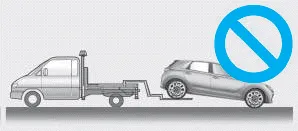
• Do not tow with sling-type equipment. Use wheel lift or flatbed equipment.

WARNING
If your vehicle is equipped with a rollover sensor, place the ignition switch in the LOCK/OFF or ACC position when the vehicle is being towed. The side impact and curtain air bag may deploy if the sensor detects the situation as a rollover.
When towing your vehicle in an emergency without wheel dollies:
1. Place the ignition switch in the ACC position.
2. Place the shift lever in N (Neutral).
3. Release the parking brake.
CAUTION
Failure to place the shift lever in N (Neutral) may cause internal damage to the transmission.
Removable towing hook
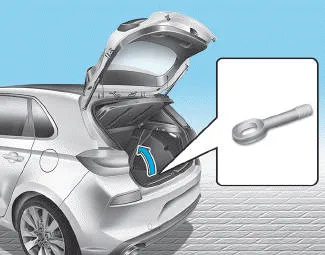
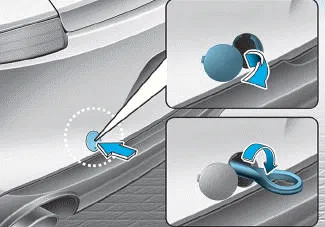
1. Open the tailgate, and remove the towing hook from the tool case.
â– Front
â– Rear
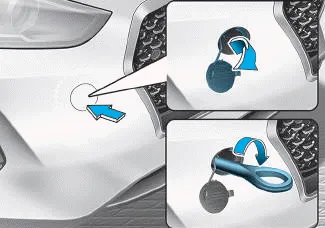
2. Remove the hole cover pressing the lower part of the cover on the bumper.
3. Install the towing hook by turning it clockwise into the hole until it is fully secured.
4. Remove the towing hook and install the cover after use.
Emergency towing
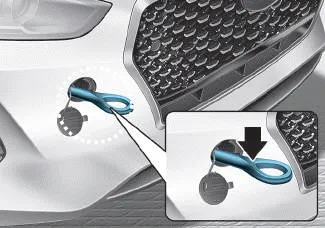
â– Front
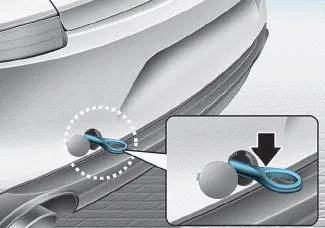
â– Rear
If towing is necessary, we recommend you have it done by a HYUNDAI authorised repairer or a commercial tow truck service.
If a towing service is not available in an emergency, your vehicle may be temporarily towed using a cable or chain secured to the emergency towing hook at the front (or rear) of the vehicle.
Use extreme caution when towing the vehicle with a cable or chain. A driver must be in the vehicle to steer it and operate the brakes.
Towing in this manner may be done only on hard-surfaced roads for a short distance and at low speeds. Also, the wheels, axles, power train, steering and brakes must all be in good condition.
Always follow these emergency towing precautions:
- Place the ignition switch in the ACC position so the steering wheel is not locked.
- Place the shift lever in N (Neutral).
- Release the parking brake.
- Depress the brake pedal with more force than normal as you will have reduced braking performance.
- More steering effort will be required because the power steering system will be disabled.
- Use a vehicle heavier than your own to tow your vehicle.
- The drivers of both vehicles should communicate with each other frequently.
- Before emergency towing, check that the hook is not broken or damaged.
- Fasten the towing cable or chain securely to the hook.
- Do not jerk the hook. Apply steady and even force.
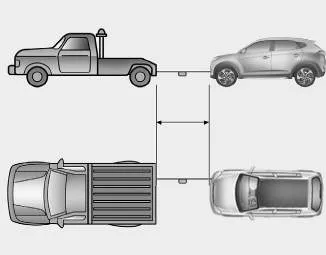
- Use a towing cable or chain less than 5 m (16 feet) long. Attach a white or red cloth (about 30 cm (12 inches) wide) in the middle of the cable or chain for easy visibility.
- Drive carefully so the towing cable or chain remains tight during towing.
- Before towing, check the automatic transmission/dual clutch transmission for fluid leaks under your vehicle. If the automatic transmission fluid is leaking, flatbed equipment or a towing dolly must be used.
CAUTION
To avoid damage to your vehicle and vehicle components when towing:
- Always pull straight ahead when using the towing hooks. Do not pull from the side or at a vertical angle.
- Do not use the towing hooks to pull a vehicle out of mud, sand or other conditions from which the vehicle cannot be driven out under its own power.
- Limit the vehicle speed to 10 mph (15 km/h) and drive less than 1 mile (1.5 km) when towing to avoid serious damage to the automatic transmission.
1. After driving approximately 7~10 km (4~6 miles or about 10 min), stop at a safety location. 2. Connect the filling hose (3) of the compressor directly to the tyre valve.
Your vehicle is equipped with emergency commodities to help you respond to emergency situation. Fire extinguisher If there is small fire and you know how to use the fire extinguisher, follow these steps carefully.
Other information:
Hyundai i30 (PD) 2018-2024 Owner's Manual: Smart cruise control (SCC) with stop & go system
➀ Cruise indicator � Set speed ➂ Vehicle-to-vehicle distance To see the SCC screen on the LCD display in the cluster, select ASSIST mode (). For more information, refer to “LCD Display Modes� in chapter 3. The Smart Cruise Control System allows you to program the vehicle to maintain constant speed and minimum distanc
Hyundai i30 (PD) 2018-2024 Owner's Manual: Driving with a trailer
Towing a trailer requires a certain amount of experience. Before setting out for the open road, you must get to know your trailer. Acquaint yourself with the feel of handling and braking with the added weight of the trailer. And always keep in mind that the vehicle you are driving is now longer and not nearly as responsive as your
Categories
- Manuals Home
- Hyundai i30 Owners Manual
- Brake/clutch fluid
- Your vehicle at a glance
- Engine coolant
- New on site
- Most important about car
