
Hyundai i30 (PD): If you have a flat tyre (with tyre mobility kit) / Checking the tyre inflation pressure
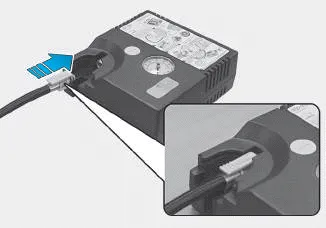
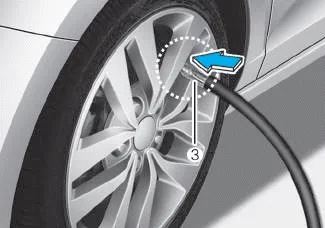
1. After driving approximately 7~10 km (4~6 miles or about 10 min), stop at a safety location.
2. Connect the filling hose (3) of the compressor directly to the tyre valve.
3. Plug the compressor power cord into the vehicle power outlet.
4. Adjust the tyre inflation pressure to the recomended tyre inflation. With the ignition swithched on, proceed as follows.
- To increase the inflation pressure
: Switch on the compressor.
To check the current inflation
pressure setting, briefly switch
off the compressor.
- To reduce the inflation pressure:
Press the button (9) on the
compressor.
NOTICE
Do not let the compressor run for more than 10 minutes, otherwise the device will overheat and may be damaged.
Information
The pressure gauge may show higher than actual reading when the compressor is running. To get an accurate tyre reading, the compressor needs to be turned off.
CAUTION
If the inflation pressure is not maintained, drive the vehicle a second time, refer to Distributing the sealant. Then repeat steps 1 to 4.
Use of the TMK may be ineffectual for tyre damage larger than approximately 4 mm (0.16 in).
We recommend that you contact a HYUNDAI authorised repairer if the tyre cannot be made roadworthy with the Tyre Mobility Kit.
WARNING
The tyre inflation pressure must be at least 220 kPa (32 psi). If it is not, do not continue driving.
Call for road side service or towing.
CAUTION
Tyre pressure sensor (if equipped with TPMS)
The sealant on the tyre pressure sensor and wheel should be removed when you replace the tyre with a new one and inspect the tyre pressure sensors at an authorized dealer.
Information
When reinstalling the repaired or replaced tyre and wheel on the vehicle, tighten the wheel lug nut to 11~13 kgf·m (79~94 lbf·ft).
CAUTION Detach the speed restriction label (1) from the sealant bottle (2), and place it in a highly visible place inside the vehicle such as on the steering wheel to remind the driver not to drive too fast.
Towing service If emergency towing is necessary, we recommend having it done by a HYUNDAI authorised repairer or a commercial tow-truck service.
Other information:
Hyundai i30 (PD) 2018-2024 Owner's Manual: Vehicle weight
Two labels on your driver’s door sill show how much weight your vehicle was designed to carry: the Tyre and Loading Information Label and the Certification Label. Before loading your vehicle, familiarize yourself with the following terms for determining your vehicle's weight ratings, from the vehicle's specifications and the Cert
Hyundai i30 (PD) 2018-2024 Owner's Manual: Tyre sidewall labelling
This information identifies and describes the fundamental characteristics of the tyre and also provides the tyre identification number (TIN) for safety standard certification. The TIN can be used to identify the tyre in case of a recall. 1.
Categories
- Manuals Home
- Hyundai i30 Owners Manual
- Speed Limiter Indicator Light. SPORT Mode Indicator Light. ECO Mode Indicator Light
- LKA system operation
- Headlamp, static bending lamp, position lamp, turn signal lamp and daytime running light bulb replacement
- New on site
- Most important about car
