
Hyundai i30 (PD): Air bag - supplemental restraint system / What to expect after an air bag inflates
After a frontal or side air bag inflates, it will deflate very quickly. Air bag inflation will not prevent the driver from seeing out of the windscreen or being able to steer. Curtain air bags may remain partially inflated for some time after they deploy.
WARNING
After an air bag inflates, take the following precautions:
- Open your windows and doors as soon as possible after impact to reduce prolonged exposure to the smoke and powder released by the inflating air bag.
- Do not touch the air bag storage area’s internal components immediately after an air bag has inflated. The parts that come into contact with an inflating air bag may be very hot.
- Always wash exposed skin areas thoroughly with cold water and mild soap.
- We recommend that a HYUNDAI authorised repairer replace the air bag immediately after deployment. Air bags are designed to be used only once.
Noise and smoke from inflating air bag
When the air bags inflate, they make a loud noise and may produce smoke and powder in the air inside of the vehicle. This is normal and is a result of the ignition of the air bag inflator. After the air bag inflates, you may feel substantial discomfort in breathing because of the contact of your chest with both the seat belt and the air bag, as well as from breathing the smoke and powder. The powder may aggravate asthma for some people. If you experience breathing problems after an air bag deployment, seek medical attention immediately.
Though the smoke and powder are nontoxic, they may cause irritation to the skin, eyes, nose, throat, etc. If this is the case, wash and rinse with cold water immediately and seek medical attention if the symptoms persist.
Do not install a Child Restraint System on the front passenger seat
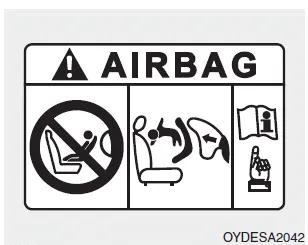
Never install a Child Restraint System in the front passenger seat, unless the air bag is deactivated
WARNING
NEVER use a rearward facing Child Restraint on a seat protected by an ACTIVE AIRBAG in front of it, DEATH or SERIOUS INJURY to the CHILD can occur.
The SRS consists of the following components: (1) Driver's front air bag module/ Driver’s knee air bag module (2) Passenger's front air bag module (3) Side air bag modules/ Side impact sensors (4) Curtain air bag modules (5) Rear Retractor pre-tensioner (6) Retractor pre-tensioner assemblies (7) Air bag warning light (8) SRS control module (SRSCM)/ Rollover sensor (9) Front impact sensors (10) Side pressure sensors (11) Passenger’s front air bag ON/OFF indicator (12) Passenger’s front air bag ON/OFF switch The SRSCM continually monitors all SRS components whilst the ignition switch is ON to determine if a crash impact is severe enough to require air bag deployment or pre-tensioner seat belt deployment.
There are certain types of accidents in which the air bag would not be expected to provide additional protection. These include rear impacts, second or third collisions in multiple impact accidents, as well as low speed impacts.
Other information:
Hyundai i30 (PD) 2018-2024 Owner's Manual: Headlamp, static bending lamp, position lamp, turn signal lamp and daytime running light bulb replacement
Type A Type B (1) Headlamp (High) (2) Headlamp (Low) (3) Turn signal lamp (4) Daytime running light (if equipped) (5) Position lamp (6) Static bending light WARNING Handle halogen bulbs with care. Halogen bulbs contain pressurized gas that will produce flying pieces of glass that could cause injuries if broken.
Hyundai i30 (PD) 2018-2024 Owner's Manual: Side repeater lamp replacement
Type A If the light bulb does not operate, we recommend that you have the vehicle checked by a HYUNDAI authorised repairer. Type B 1.Remove the lamp assembly from the vehicle by prying the lens and pulling the assembly out. 2.Disconnect the bulb electrical connector.
Categories
- Manuals Home
- Hyundai i30 Owners Manual
- Headlamp, static bending lamp, position lamp, turn signal lamp and daytime running light bulb replacement
- Your vehicle at a glance
- Fuses
- New on site
- Most important about car
