
Hyundai i30 (PD): Interior features / Barrier net (wagon)
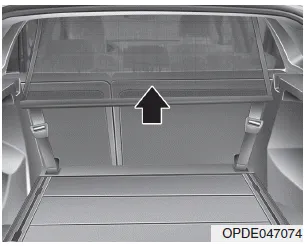
Your vehicle is equipped with a barrier net.
When you load some cargoes on the rear seat or rear cargo area, you must install the barrier net behind front or rear seatback.
It is designed to help protect the heads of the occupants by obstructing objects flying forward in frontal collisions.
There are eight hook holders: two each on both sides of the headliners over the head restraints for upper side fixation and four on the floor behind the front or rear seats for lower side fixation.
To install the barrier net
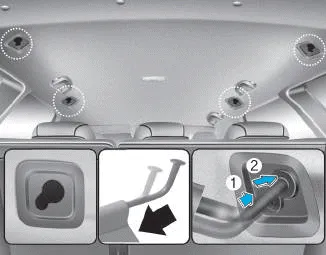
1. Compress and push one side of the net shaft longitudinally towards the large hole (1) until it touches the upper side. Then, secure by sliding into the small hole (2).
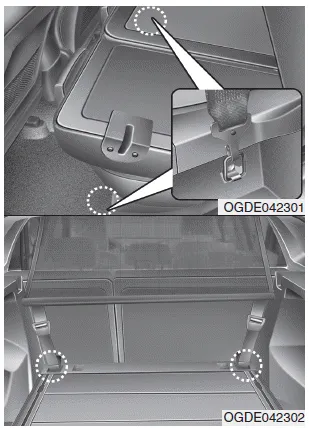
2. Fasten the net strap hooks to the corresponding hook holders on the floor behind the front or rear seats.

This symbol indicates the location of the hook holders on the floor behind the rear seat.
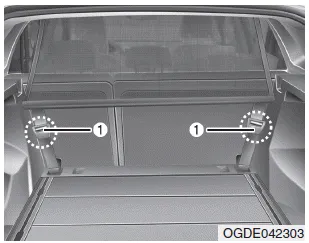
3. Fasten the straps, using the adjuster (1).
WARNING
- Make sure that there is no slack in the barrier net by fastening the strap securely when installing the net. The strap should be fastened after confirming that the hook is inserted into the upper hook holder securely.
- Make sure that the seatbacks are locked securely.
WARNING
- Do not ride in the rear seat or cargo area behind the barrier net.
- Do not ride in the rear centre seat when the barrier net is installed behind the rear seats. The barrier net may interfere with use of the rear centre safety belt.
- Do not load cargo in the area higher than the barrier net's upper end.
- Do not load heavy cargo in the area higher than the seatback to avoid accident even if the barrier net is installed.
- Do not load cargo which has sharp edge that can penetrate the barrier net.
- Do not apply excessive force to the barrier net by hanging on to the net or suspending heavy cargo , etc.
To remove the barrier net
1. Loosen the straps using the strap adjusters and remove the strap hooks from the hook holders.
2. Remove the net upper shaft by pulling it through the large holes.
3. Remove the barrier net.
Use the cover to hide items stored in the cargo area. The cargo area cover will lift when the tailgate is opened. Disconnect the strap (1) from the holder if you want to return the cover to the original position.
Use the cargo security screen to hide items stored in the cargo area. NOTICE Since the cargo security screen may be damaged or malformed, do not put luggage on it when it is used.
Other information:
Hyundai i30 (PD) 2018-2024 Owner's Manual: If the engine overheats
If your temperature gauge indicates overheating, you experience a loss of power, or hear loud pinging or knocking, the engine may be overheating. If this happens, you should: 1. Pull off the road and stop as soon as it is safe to do so. 2.
Hyundai i30 (PD) 2018-2024 Owner's Manual: Wheel alignment and tyre balance
The wheels on your vehicle were aligned and balanced carefully at the factory to give you the longest tyre life and best overall performance. In most cases, you will not need to have your wheels aligned again. However, if you notice unusual tyre wear or your vehicle pulling one way or the other, the alignment may need to be reset.
Categories
- Manuals Home
- Hyundai i30 Owners Manual
- Your vehicle at a glance
- Headlamp, static bending lamp, position lamp, turn signal lamp and daytime running light bulb replacement
- Specifications & Consumer information
- New on site
- Most important about car
