
Hyundai i30 (PD): Manual climate control system / Heating and air conditioning. Fan speed control
1. Start the engine.
2. Set the mode to the desired position. To improve the effectiveness of heating and cooling, select:
- Heating: 
- Cooling: 
3. Set the temperature control to the desired position.
4. Set the air intake control to the outside (fresh) air position.
5. Set the fan speed control to the desired speed.
6. If air conditioning is desired, turn the air conditioning system on.
Mode selection
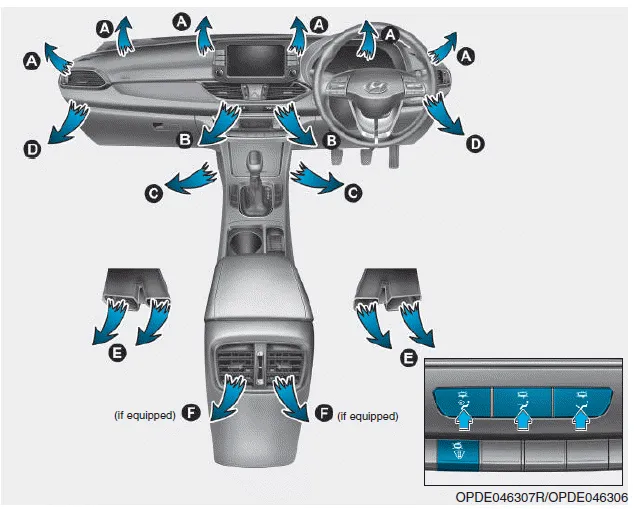
The mode selection button controls the direction of the air flow through the ventilation system.
Air can be directed to the floor, dashboard outlets, or windscreen.
Defrost-Level (A, D)

Most of the air flow is directed to the windscreen.
Face-Level (B, D, F)

Air flow is directed toward the upper body and face. Additionally, each outlet can be controlled to direct the air discharged from the outlet.
Floor-Level (A, C, D, E, F)

Most of the air flow is directed to the floor.
Also you may select 2~3 modes at the same time.
- face ( ) + floor (
.webp) )
mode
)
mode
- face ( ) + defrost (
.webp) )
mode
)
mode
- floor ( ) + defrost ()
mode
) + defrost ()
mode
- face ( ) + floor ()
+
defrost (
) + floor ()
+
defrost ( ) mode
MAX A/C-Level (B, D, F)
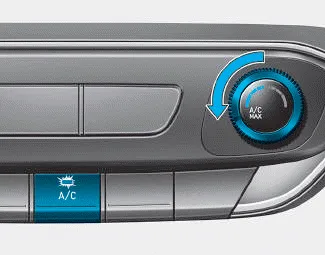
To operate the MAX A/C, turn the temperature control knob to extreme left. Air flow is directed toward the upper body and face.
In this mode, the air conditioning and the recirculated air position will be selected automatically.
After the interior has cooled sufficiently, whenever possible, move the temperature knob away from Max AC and press the A/C button.
Instrument panel vents
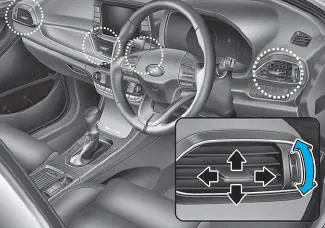
â– Front
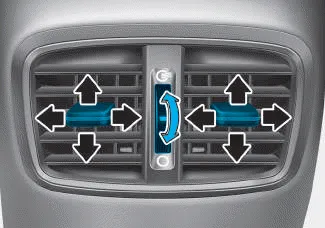
â– Rear
The outlet vents can be opened ( )
or closed (
)
or closed ( ) separately using the
thumbwheel.
) separately using the
thumbwheel.
Also, you can adjust the direction of air delivery from these vents using the vent control lever as shown.
Temperature control
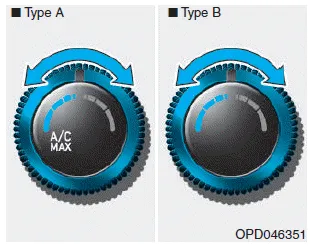
The temperature will increase by turning the knob to the right. The temperature will decrease by turning the knob to the left.
Air intake control
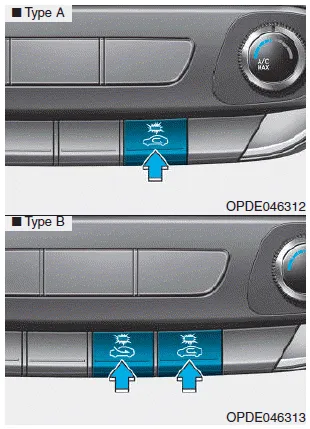
This is used to select outside (fresh) air position or recirculated air position.
To change the air intake control position, press the control button.
Recirculated air position

With the recirculated air position selected, air from the passenger compartment will be drawn through the heating system and heated or cooled according to the function selected.
Outside (fresh) air position

.webp)
With the outside (fresh) air position selected, air enters the vehicle from outside and is heated or cooled according to the function selected.
Information
Using the system in the fresh air position is recommended.
Prolonged operation of the heater in the recirculated air position (without air conditioning selected) can cause fogging of the windscreen and side windows and the air within the passenger compartment will become stale.
In addition, prolonged use of the air conditioning with the recirculated air position selected will result in excessively dry air in the passenger compartment.
WARNING
- Continued climate control system operation in the recirculated air position may allow humidity to increase inside the vehicle which may fog the glass and obscure visibility.
- Do not sleep in a vehicle with the air conditioning or heating system on. It may cause serious harm or death due to a drop in the oxygen level and/or body temperature.
- Continued climate control system operation in the recirculated air position can cause drowsiness or sleepiness, and loss of vehicle control. Set the air intake control to the outside (fresh) air position as much as possible whilst driving.
Fan speed control

Turn the knob to the right to increase the fan speed and airflow. Turn the knob to the left to decrease fan speed and airflow.
Setting the fan speed control knob to the “0� position turns off the fan.
NOTICE
Operating the fan speed when the ignition switch is in the ON position could cause the battery to discharge. Operate the fan speed when the engine is running.
Air conditioning (A/C)
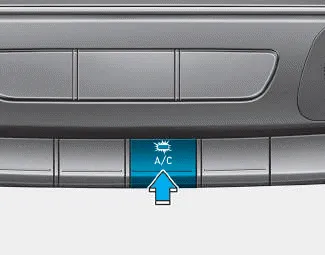
Press the A/C button to turn the air conditioning system on (indicator light will illuminate). Press the button again to turn the air conditioning system off.
â– Type A â– Type B 1. Fan speed control knob 2. Temperature control knob 3. Mode selection buttons 4. Front windscreen defroster button 5.
Ventilation 1. Set the mode to the position. 2. Set the air intake control to the outside (fresh) air position. 3. Set the temperature control to the desired position.
Other information:
Hyundai i30 (PD) 2018-2024 Owner's Manual: Notes on the safe use of the Tyre Mobility Kit
Park your car at the side of the road so that you can work with the Tyre Mobility Kit away from moving traffic. To be sure your vehicle will not move, even when you're on fairly level ground, always set your parking brake. Only use the Tyre Mobility Kit for sealing/ inflation passenger car tyres.
Hyundai i30 (PD) 2018-2024 Owner's Manual: Check tyre inflation pressure
Check your tyres, including the spare tyre, once a month or more. How to check Use a good quality tyre pressure gauge to check tyre pressure. You can not tell if your tyres are properly inflated simply by looking at them. Radial tyres may look properly inflated when they are under-inflated.
Categories
- Manuals Home
- Hyundai i30 Owners Manual
- Engine oil
- Scheduled maintenance services
- Battery replacement
- New on site
- Most important about car
